Envision this: you wake up to the sun shining in your eyes on a beautiful and warm January day…? In the recent years it is not uncommon to find certain weather on days it does not belong. Small changes in the environmental structure of our own biospheres are easy to spot such as water levels rising, cold days during warm months, or extended seasons that may be unwanted to some. People may complain and blurt out “Damn You Global Warming!” Others thank the heavens for allowing us to wear shorts in December. Many skeptics do not see this as a problem because the region in which they reside is not directly affected by this problem. However, do you ever consider the lives of organisms whose home and surrounding habitats are affected daily by this earth shifting movement? Many may have heard of the problems faced in the arctic region that are cutting down numbers of those cute little polar bears, but did you know that many other species are being harmed by these transformations? Would it surprise you to know that there are animals in all regions such as rain forests and oceanic areas that are fighting to survive every day? Furthermore, do you realize that the changes made in all of these regions can and will come back to affect the biospheres in which we all life if we do not address this now?
In this website we will take you through an information journey using mediums of comedy, drama, and yes…even horror! It must be kept in mind that the information being released on this website is true and is also rapidly changing the Earth’s biospheres. Before you reach the bottom of this page you will be informed on the dangers Earth faces due to Global Warming’s affects on the forestry region forcing deforestation, the many species who call the arctic their home, the un-discussed changes exerted onto our ocean’s water level that is changing a lot more then you think, and finally all of those terms being thrown around recently that may make you feel a little left out. So, please, keep all hands, legs, and carbon footprints inside the coaster at all times. And enjoy the ride, that is at least what you can enjoy of the ride!
“ALL THEM DAMNED TERMS!”
In order to properly delve into the issue of Global Warming, we must first inform you on all of those new hip terms that catch us off guard. Who knew that the Earth was like a greenhouse, or that our actions leave footprints? In this next section we will be looking at the terms related to climate change and dissect what they actually mean. To get things started let’s look strait into the eye of the storm…“Global warming” is caused by a fluctuation in temperature that reflects back and forth from the atmosphere and the ocean. These causes are claimed to be by human influence, otherwise known as “carbon footprints”. The term “Global Warming” was created to explain the human affect on the overall climate change to open the eyes of the human race and express that there is something WE can do to soften the blow. All other unknown sources fall under the general “climate change” category. The term “Greenhouse Effect” was created to first examine an enemy so that us, as humans, can have an entity to focus our attention on. To go along with this effect, the term “greenhouse gases” were named referring to the radiant energy produced by the sun that get trapped between the Earth and its atmosphere, that would normally be radiated back into space if it wasn’t for the increase in CO2 that is built up by our “carbon footprints”, like heat gets trapped in a greenhouse. Our “carbon footprint” is a term that was created to explain the many, many things us, as humans, do that add to this “greenhouse effect”. So essentially the build-up of carbon gases is creating an invisible glass ceiling for our Earth. You don’t want to continue being trapped here do you? (MarineBio Society)
Ok…It’s time for a recap! Below you will find the scientific definitions of all of these terms in an easy to read dictionary provided to you by the American Heritage Dictionary of English Language. Each Definition will be accompanied by examples of visual aids with either humorous or serious undertones to explain the different ways Global Warming is advocated.
**********************************************************************
Global Warming (n.) - An increase in the average temperature of the earth's atmosphere, especially a sustained increase sufficient to cause climatic change.
Visual Aid for Global Warming – The following video is more of a spoof on our late president George W. Bush, but is a good example of how many people advocate Global Warming awareness but don’t know what the heck they are talking about. This is why we are putting this out there for people. So, watch and enjoy…
***********************************************************************
Climate Change (n.) - periodic modification of Earth's climate brought about as a result of changes in the atmosphere as well as interactions between the atmosphere and various other geologic, chemical, biological, and geographic factors within the Earth system
Visual Aid for Climate Change – For the visual aid chosen for Climate Change I decided to take a more serious approach to it. In this picture found on politicalhumor.com, there was an open forum to submit serious pictures on effects of Climate Change. This one was a digital print of what would happen if the occurrences happening in the arctic region happened in our world; To be more specific, New York City. It is scary to think of what our lives would be like if we had to dodge climate/earth changes like this one…

http://politicalhumor.about.com/od/funnypictures/ig/Funny-Global-Warming-Pictures/New-York-City.html
Greenhouse Effect (n.) - The phenomenon whereby the earth's atmosphere traps solar radiation, caused by the presence in the atmosphere of gases such as carbon dioxide, water vapor, and methane that allow incoming sunlight to pass through but absorb heat radiated back from the earth's surface.
Visual Aid for Greenhouse Effect – The Visual aids for the Greenhouse effect are harder to locate on the internet, however I happened to come across some visual aid that does way more advocating for the viewer then a humorous cartoons or a proposed nightmare. The following image is an in depth diagram found on an independent blogger’s webpage. It can really explain the effects of the greenhouse effect quite nicely…

http://joel-thedarkness.blogspot.com/2008_05_01_archive.html
Carbon Footprint (n.) - a measure of the amount of carbon dioxide produced by a person, organization, or location at a given time.
Visual Aid for Carbon Footprint – The visual aid I found for the carbon footprint is another humorous one. It is a comic strip that takes place during biblical times when Prometheus was forced to live eternity with birds pecking at his skin. While conversing with one of these birds, the bird points out that he is not producing a carbon footprint so he is doing his part. It is funny and true. There are lists of things that anyone can do in order to reduce their carbon footprint daily thus contributing to the overall cause of lowering the CO2 level, thus aiding in the elimination of the Greenhouse effect. Lets see how this bird contributes…

Now that you are properly informed on the terms used to explain Global Warming and its causes, it is time to properly inform you on the changes made to the different Biosphere regions around the world. Continue onward for additional information on the regions of the ocean, the arctic, and the forests…
OCEANIC REGION
It may come as a surprise that the oceanic region is one of the most debilitated biospheres from Global Warming and Climate Change. A large amount of the attention is focused on the world’s polar regions due to the support behind saving the polar bears, and the more populated regions of the world. However, what many do not realize is all of the run off created by the ice caps melting and the shore lines receding only poses more danger to the organisms who call the ocean their home; In fact, the runoff caused by these melting landforms result in the rising of the sea level. When the water level rises this affects the weather worldwide.
There are four main environmental transitions occurring daily that pose a serious threat to oceanic life (All of the following information has been provided by Action Bio Science, an online site created to spread the word on environmental changes):
- The first, and most noticeable by the human race, is the dramatic increase in the Earth’s temperature. The world temperatures, as a whole, have reached a record high for a consecutive decade. This may be nice for your family vacation or a day at the beach, but many organisms are harmed daily by this.
- The second transition is the retreat of coastal shorelines. This basically means that the melting of the ice caps have caused the shorelines to be pushed back.
- In addition to the coastal lines, many island nations are losing valuable land used for habitable areas, which has resulted in a decrease of overall populations on the world’s islands.
- Finally, there are an uncountable amount of countries that are having glaciers melt on a daily basis, which continues to contribute to the rising of the water level and destroy surrounding land.
In the following section I will take a closer look into these reoccurring problems that contribute to the overall problems faced by the world’s organisms. In doing this I will utilize the visual aids provided on the Internet.
Increase in Temperature
As mentioned previously the temperature has hit a record high in the past decade then has ever been recorded before. This is due to the increase in use of carbon-based fuels contributed by humans all over the world. It is estimated that if the use of carbon fuels continues at this rate, then the amount of carbon dioxide in the air will double by 2100. This would further result in water level rising, which moderates the average global temperature. If the water level raises further, humidity levels will rise as well, which in turn rapidly increases the overall temperature even further. To get a better understanding of how much the temperature has increased over the past decrease, the U.S. National Climate Data Center has provided a graph to note the increase up until the year 2000. The average overall temperate has increased dramatically since then (Chanton):

Of all of the issues that hinder oceanic life, the issue of rising temperature is taken most lightly. Many individuals are not in the least bit phased by the growing problem because when they wake up in the morning, they get a warmer day to live with. However, many oceanic life forms are not equipped to adapt to the changes brought on by climate change. Although it is brought on by a chain reaction, the overall number of small fish is decreasing due to a lack of food. It starts with the nutritional value of algae. Researchers from the Netherlands Institute for Ecology have found that the nutritional value of algae has decreased because their natural composition is changing rapidly. In other words, it is like diluting a drink with more water, the taste becomes less concentrated. Because algae is at the bottom of the food chain, every ocean species that lives off of algae or organisms that live off of algae are being affected by this (ScienceDaily).
In addition to the nutritional value of algae being harmed by this, the acid level throughout the ocean had increased dramatically in the past couple years. According to an written by Rachel Nowak from News Science, about 40% of carbon dioxide emitted by humans within the past two centuries currently remains in the ocean's water supply. This can pose serious dangers to many fish and their environments. Coral Reef fish, such as Clownfish, use their senses to find their way at their larva state to the reef. Due to the depletion of the coral reefs and the distraction due to CO2 from the larva's senses, many are not finding their way back, thus dying out in this stage. If this continues, many coral reef fish species may become extinct, which would in turn destroy the coral reefs due to the communal nature of these areas. (Nowak)
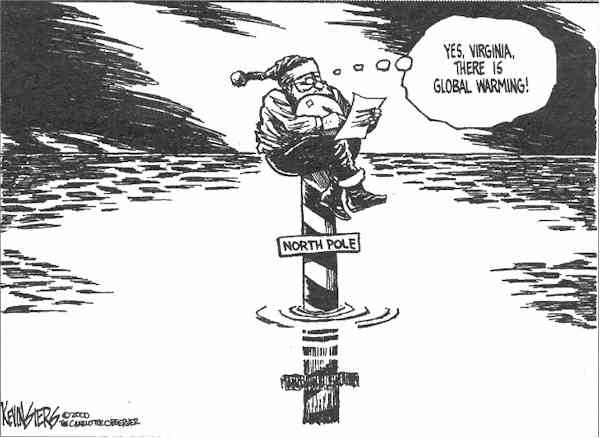
However, these issues are never mentioned in the media because the glamour of increased temperature is too good to see past. A good example of this humorous view is shown below:

http://www.riverwired.com/files/u9/05_0708_cartoon_large.gif
Retreat of Coastal Shorelines
The retreat of coastal shoreline is a growing problem brought on by Global Warming. This poses a huge problem for many US states because land that is currently being used as habitant land is rapidly decreasing, resulting in less places to live and overpopulation in other areas of the country. According to a study compiled by the Natural Resources Council of Maine, 20 communities are being damaged due to the rise in water level. From York County to Beals County up to 30% of land used as for community areas are being eaten by the shoreline. This has resulted in millions of dollars in damages. The NRCM has estimated a total of a six-meter increase, as opposed to the current one-meter increase, in water level resulting in a total of 128,000 acres being at risk of submersion. This could potentially destroy 380 miles of road along the Maine coastline. This is a rising problem that is almost impossible to dodge at this point and these statistics are only from Maine. (Maine Coast)
This is also contributing to the dilution of algae related organisms. In addition to algae dilution problem posed on water animals, organisms that survive along the coastal regions are also losing valuable areas to raise their young. This issue is posing more of a problem to the areas being harmed by it, yet some still find the ability to take the decrease of these landmasses lightly. Take this following image for example:

http://www.flatrock.org.nz/topics/environment/assets/global_warming_cartoon.jpg
Decrease of Island Land
Due to dramatic impacts of rising water levels, the ocean is displacing many islands all over the world. Many islanders have to watch as the ocean begins its tyrannical rule over their lives and possessions. For 20 years the islanders of the Carteret Islands have battled with this dilemma by using sea walls in attempt to redirect the ocean’s fury. The Carteret Islands is a horseshoe shaped chain that exists close to the New Guinea coast. Over 2,000 citizens recently inhabited this area, until the water level began to rise. Taking into consideration that the ocean is the driving force behind our planets weather, not to mention it takes up over 70% of the Earth’s surface, it is a force that is almost impossible to stop. Finally in late 2007, after years of struggle, the inhabitants became refugees of their own land, being driven back to the coast and moving to New Guinea or resettled in Bougainville, a nearby island that can be reached with a 4-hour boat ride. $569 million dollars was used in the effort to stop this from happening. Only $712,000 was saved and will be given back to the islanders to help rekindle their lives. (Jenkins)
In addition to the thousands of lives that have been displaced due to the water level rising, it is predicted that all surrounding coral reefs will be destroyed leaving millions of sea species lost…and possibly extinct (Jenkins). Below is a comical editorial interpretation of how sea life is viewing this growing problem:

http://farm4.static.flickr.com/3196/2957713468_fdd3c15c0d.jpg?v=0
Depletion of Glaciers
The depletion of glaciers around the world pose many threats to the surrounding wildlife, as well as civilizations that exist in these areas. It was reported by Georg Kaser, a leading glaciologists on the University of Innsbruck (Austia) team, that 99.99% of all glaciers are now shrinking. It may come as a surprise that the melting of these glaciers do far more to our world’s well being, besides the dangerous floods. The melting of these land glaciers destroys any mountainside habitat, trailing millions of pounds of waste into the oceanic biosphere. In addition, it destroys many crops that help small villages survive. It was estimated that water supply in Columbia, Chile, Ecuador, Argentina, Bolivia, and Peru would all be contaminated because of the run off. This can further result in depletion of food supply and many citizens’ livelihoods. (Adam)
This helpful picture aids in understanding the dangerous paths in which these glacier run offs can hit nearby cities:

http://www.gearthblog.com/images/images1206/glacier.jpg
Dr. Kaser found in the 1990’s ice based countries such as New Zealand and Norway grew dramatically due to increased snowfall. Since the rise in the Earth’s temperature, these countries have started to decrease in size. Strong facts like this have proven that this has been occurring due to the increase in climate change. Furthermore, many countries are decreasing by the year. This same study found that the Eastern Himalayas have shrunk by about 30% since the 1970’s.
The following is a comical, yet scary, depiction of how glaciers are flowing into the oceanic region (without the knowledge to stop them):

ARCTIC REGION
 When arctic climates begin to get warmer and warmer, concern for the future of the arctic ecosystem is only part of the problem. The melting of the polar ice caps is going to contribute to the rise of all the seas and oceans. There will be a decrease in salt water and a big increase of fresh water. With less salt water, all the oceanic inhabitants whom depend on salt water to live in will eventually become extinct. The lack of salt water can also affect the circulation of the water. “Arctic tundra also stores huge amounts of carbon, which could be released to the atmosphere during a thaw, further enhancing the greenhouse effect and global warming.” (The Pew Center on Global Climate Change) We must remember that this “global warming thing” is a domino effect. Once one habitat is disrupted it disrupts other habitats all over the world.
The arctic is the first place most people think of when it comes to climates being affected by global warming. Everyone seems to hear something about how all the ice is melting because of rising temperatures. Although we can all agree that the earth is getting warmer and the polar ice caps are significantly shrinking, not everyone will agree that global warming is the cause. But regardless about what people think, the ice is melting and this ice is home to many arctic animals such as the polar bear, the arctic fox, and seals.
Apparently the polar bears are burning up considering there of videos on the internet showing a polar bear shaving off all of its fur. As the viewer watches the video of the polar bear shaving, accidentally cutting itself, and making a cute yelping noise, they are able to laugh about it because let’s be honest, where did that polar bear even get an electric razor and why is there an electrical outlet in the middle of an arctic snowstorm? On the serious side of things, polar bears are actually dying off. “The chief threat to the polar bear is the loss of its sea ice habitat due to global warming“ (National Wildlife Federation 1). As the ice melts the polar bears have less and less room to live, raise their cubs, and hunt for food.

These polar bears are swimming in hopes of finding a last dinner as the little cub is struggling to stay above water. The punch line is that one of the polar bears comment, “I can think of a few climate change naysayers in the white house I’d like to sink my teeth into.” Again, this cartoon makes the reader laugh, but the truth is that the polar bears have been denied a spot on the endangered species list for years now because the government does not think that there is a huge concern. But in fact, that only thing on the governments mind is creating more oil plants and other types of plants in order to create jobs. Things are about to change. The Bush administration, which would never openly admit to global warming being real, has now come to a close and Bush is out of office. Barack Obama, the new President, believes that global warming is real and we have to do something to help slow the process down NOW. Another truth to this cartoon is that the polar bears are being left to drown. Polar bears can obviously swim, but only for so long. Since ice floes are becoming so far apart, polar bears are unable to swim all the way to the next floe. So, they die.

Seals have it bad as well. The seals are dealing with most of the same issues that the polar bears currently are. Some of the seal species hardly ever come on land and have to depend on the arctic sea and ice for a habitat. Without the ice they will have no place to rest, give birth, or raise their young. As the ice becomes more and more scarce, the seals will be forced to live on land. Specifically, the ringed seals will have the hardest time adapting to living on land because they are hardly ever leave to water.

As the seals lose more and more of their habitat and are forced to live on land, they will face extreme hardships as well as a quicker extinction. Seals are small, defenseless, and are hunted by much bigger and stronger animals like the polar bears. As the seals have their babies in the spring, the ice must be think enough to be a habitat for the seals to help prevent separation of mother and pup. If the pups die, there would be no chance for survival of their race.

Alright, so foxes should not be perceived as alcoholics, but they are another type of arctic species threatened by global warming and they are pissed that other foxes are taking over their habitat. The arctic fox is a land dweller and moves a lot faster than the polar bear or the seal. Though they can move faster and possibly get to another cold habitat before the ice is completely gone, scientists believe that the fox is not migrating, but just disappearing, considering the apparent decline in population. In Finland, the arctic fox is thought to be almost fully extinct and are on the critically endangered list.
Some of the hardships the arctic fox has had to endure due to the affects of climate change in its region include having to protect themselves more from other animals. They are a lot less aggressive than their close relative; the red fox. The red fox threatens their habitats and if the habitat is taken over by the red fox, the arctic fox will be killed. As the temperature rises the red fox will start to migrate, as they already have, into the areas where the arctic fox lives.
 Finally, there will be death. Death will be the end result if nothing is done to help stop global warming. The extinction of the polar bears, arctic fox, seal, and the other arctic animals being affected by the climate change global warming is a harsh reality. Though we laugh at these cartoons now, the truth in these videos and cartoons are brutally blunt. The arctic seas are melting as the earth continues to burn up and it seems like the only way to catch the attention of the audience is to make a joke out of it. If the reader looks deeper at the true meaning of these messages then maybe, just maybe, some change can be made in order to help save our little furry, arctic animals.
It is estimated that more than half of the world’s animal species live in rainforests. There are many different layers making up the rainforest, such as: the Emergent Layer, the Canopy, the Understory, and the Floor. Each of these layers are like their own little ecosystem for millions of species of animals and insects.
The Emergent Layer is where certain trees reach 200 feet or more. They do not grow close together and receive more sunlight, but less moisture than other rainforest trees. A variety of insects inhabit this layer, as well as some species of bats and birds, like the Harpy Eagle.

The Canopy is the area where trees grow to heights between 100 and 150 feet. Some animals inhabiting the Canopy are; Lemurs, Spider Monkeys, Sloths, Toucans, Orangutans, and Parrots. These animals find most of their food in the Canopy, so they never really need to visit the rainforest floor. This layer acts as a “reverse umbrella” to the rainforest by trapping moisture and humidity underneath the leaves of its trees and also blocks out sunlight.

The Understory is the layer between the Canopy and the Floor. The leaves of the trees here are very large and broad so they can capture the little bit of light that gets through the Canopy. This is a very dark and humid layer, giving home to a large amount of insects.
The Rainforest Floor only receives 1-2% of the sunlight that hits the upper layers of the rainforest. Due to the lack of sunlight, very little plant life is found here. The floor is very humid due to the evaporation of water from the leaves and shrubs found there. A variety of insects inhabit the floor, as well as some larger animals like; Jaguars, Bengal Tigers, Okapis, and Southern Cassowaries.

Many of these animals have special adaptations allowing them to live in tropical conditions, but they would not survive outside of this ecosystem. Deforestation is really doing no good for the world. All the carbon being emitted by the cutting and burning is only negatively effecting what’s left of the rainforests, as well as the rest of the Earth. It is destroying the homes of millions of species of insects and animals, forcing them with no other alternative than to die. Sure, some will be saved and put in Zoo’s, but it will never be like the home they once knew. We shouldn’t destroy something so innocent, natural, and beautiful.




Beautiful layout of the website! I like your into and the side navigation bars. I think you forgot to add your videos and images at the last paragraphs and in place it says [PICTURE OF.. VIDEO OF..] Don't forget to add that stuff! It well help shed some light and create more of an entertaining aspect. All in all, pretty solid draft, I just think you need the images that it looks like you forgot to put in.
ReplyDeleteGood persuasion and informing, I like your description of wearing shorts in December and waking up in January to a beautiful, warm, sunny day..great and the readers can relate!
All in all, solid draft! I like the way it is set up and the poll--very neat!
Fire-starters,
ReplyDeleteI am a bit confused by the various drafts of the sections.
I can see how you are inserting media pieces, but it's hard to gauge the effect without it actually being there.
There are some proof-reading issues.
Content-wise the intro and arctic appear to be the most developed. In the arctic section, the statement downplaying global warming as the cause undercuts your other statements.
I like that you all are trying to tie effects caused by GW in one bioregion with effects in the others. That's important to do.
effect=noun!
I will comment more later when you have it further along.
Yeah -- sorry guys, my pictures are coming soon. I just could not get the pictures in the right place. I won't forget about them!
ReplyDeleteIt looks like you guys have a little work to do to complete this draft on the technical end but when those visuals are in place this site will be a very successful campaign that employs all three of the devices to make your point. I think the writing is well-planned and comes off informal, giving you a credible voice. It is more of a running dialogue trying to get people to see it your way and you refer directly to your visuals to accomplish this. The layout looks good. The information is there. And it is presented in a way that has fun with the topic through the writing. Overall my impression is that this group presented a great deal of information to help back their arguments and expressed clearly how they were going to do it from the start so the reader was ready. It is also the best example of engaging the reader directly through the interactive aspects of the site. Good Work. Get those pics.
ReplyDeleteThe intro is a good attention-grabber. I did notice some grammatical errors, but it seems like you guys are going to be adding some stuff still, so I'm sure you'll do more proofreading. It was a little confusing the first time I went through because I didn't understand where the draft ended and where your other posts for each other started. I think that your use of media and videos will be very convincing as well as entertaining, when you get them up!
ReplyDeleteIt seems like you guys have done a great job researching; the layout seems great for this type of project. It also seems like you found a lot of great media to include, I'd be excited to see the final product.
ReplyDeleteThere were a few proofreading errors (ex. forest not forrest), I would give your draft another read-through before the final project is turned it.
Good start!
I feel like the first sentence is a little awkward. It shouldn't end in a question mark. I like that you had links to videos on the side and you had a poll. It made it very "website like". There currently isn't a lot of entertainment to it, but I think once you put in the videos, cartoons, etc., it should be okay.
ReplyDeleteBe careful with the words affect and effect. At least once, you used one when you should have used the other. There were a few other typos, just be sure to proofread before you post your final draft.
The website is extremely informative. It does a fairly good job of persuading too.
Overall a pretty good draft. Just a little revision and it should be good!!